Sarajevo, Bosnia-Hercegovina, 2000
Competition entry, in collaboration with Yann Coulouarn, France
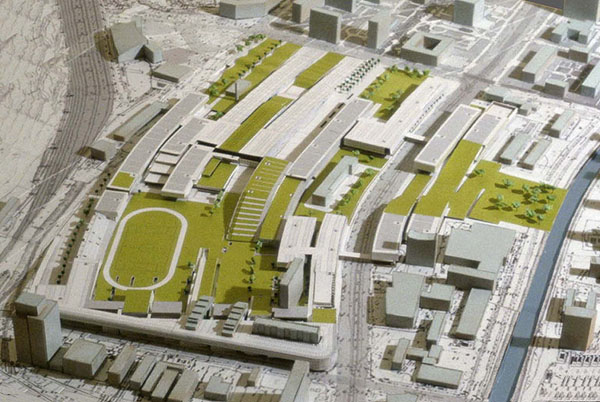
1. View of model
The project for the Sarajevo University Campus aims at campus typology at large.
Rather than pursuing a scheme of arranging discrete objects in a field, the project
accepts the scale of its programmatic, symbolic and F.A.R. ambitions and then attempts
to create something both collossal and cozy.
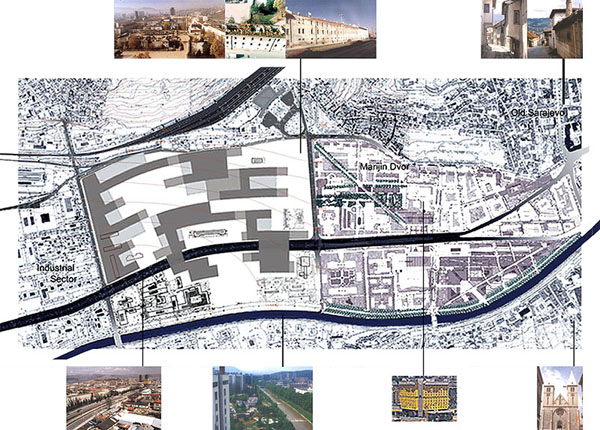
2. Site Concept and Context
Site influences coupled with the adaptation of a class of Self-Avoiding Space-Filling
curves generate the possibility of creating two directional modes, one oriented band-like
and running parallel to dominant site elements, another operating transversally, providing
the sectional clearance and spatial cross-connection necessary for both modes to modulate
with greater degrees of freedom.
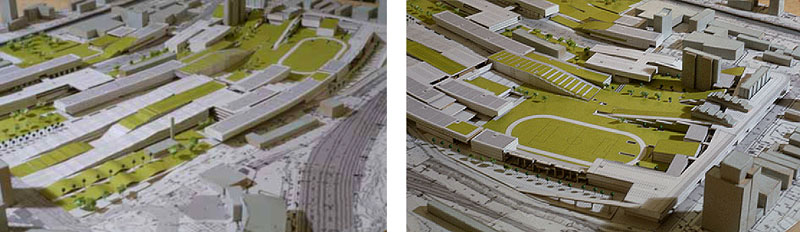
3. Model Views
4. Self-Avoiding Space-Filling Curves
Paradoxically, the following conditions during the siege suggested some positive ways to
begin thinking about the project. 1) A network of contiguous spaces and supply routes was
formed to protect civilians from sniper fire. 2) Spaces were constantly modified to adapt to
immediate necessities, requiring an opportunistic approach to the available architectural
situation. Such accelerated adaptive reuse became a source of inventive strategies to deal
with scarcity: gardens were created anyplace where there was space and light, recycling
became routine, solar cells and makeshift batteries provided micro-power solutions when the
electricity was cut off. 3.) The necessity of camouflage encouraged a disconnection between
a building's form and its function. 4) The aggregate effect of these conditions created a
vast yet ambiguously bounded architectural totality.